

How To Fix Gel Coat Cracks
Past Terry Monville – GBI Technical Advisor
Knowing how or why your boat'due south gelcoat cracks occurred in the first identify is the key to a successful repair. For case, if hit a seawall or dropping a champagne bottle on deck is what acquired the cracks, after fixing them you volition know how to prevent them in the future: Don't drink the champagne causing yous to hit the seawall and drop the bottle.
Then in that location are those cracks that seem to announced in the gelcoat from nowhere: in cabin and cockpit corners, around screw holes, or in the center of the deck. It can be hard to figure out what caused them.
So, What is Gelcoat?
Gelcoat is a pigmented, loftier-quality polyester resin used equally the finish on fiberglass boats. Like any other polyester resin, it has proficient points and bad. Allow'south look at some of the bad points that lead to groovy.
After it's applied, gelcoat shrinks 4 to seven per centum during the cure and can have less than 1 percent elongation. This contributes to gelcoat'south dainty difficult stop which nosotros like, but also makes gelcoat brittle, particularly if it was applied thicker than recommended.
Gelcoat should be about 20 mils (.020 of an inch) thick when the manufacturer properly applies it to the mold. Merely when the builder sprays gelcoat on the mold of a boat deck with motel pinnacle corners and seat backs, the edges tend to go more than needed. Or the gelcoat runs down and builds upward in an inside corner, or too much or too picayune gelcoat gets sprayed on the whole mold.
Minor Single Line Gelcoat Cracks
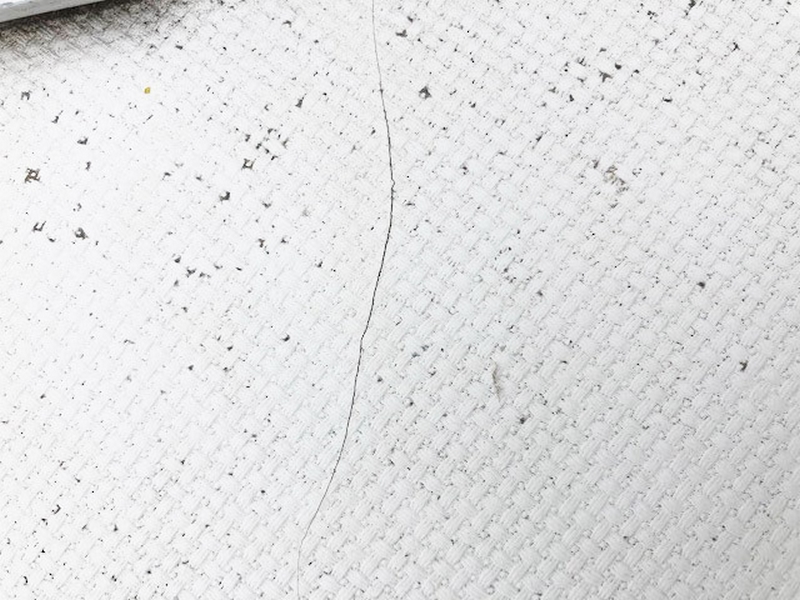
A minor unmarried-line gelcoat scissure.
Thick areas of gelcoat don't have reinforcing fabric to aid concord information technology together. The stress is relieved in the course of a cleft. This tin can happen when the role is pulled from the mold or years down the road, where a little more than stress is introduced from the part flexing. Mostly, these cracks will appear as unmarried-line gelcoat cracks in the cabin or cockpit. This type of smashing is difficult to avoid and is office of boat ownership. Luckily, the repair is simple and straightforward, every bit I'll explain later.
Another common fissure is a spiral hole crevice: a hairline crack or two coming from a piece of deck hardware. This can happen after a self-tapping or canvass metallic screw is used to add a slice of hardware, even if you've used a proper pilot hole for the spiral. The threads on the screw create force per unit area on the gelcoat causing information technology to crack. Not using a pilot hole, or using one that is too small, will create even more of an issue. They are often seen around snaps for canvass and beverage holders. When mounting hardware with cocky-borer screws, you should drill the airplane pilot pigsty and then countersink to remove the gel-coat to the threads' bore. This volition prevent the threads from creating pressure level on the gelcoat and make a pocket-size pocket for sealant to aid seal the screw.
Repairing Minor Gelcoat Cracks
- Use a rotary tool or scraping tool to open the crack into a "Five" shape. You volition need to become through the gelcoat to the fiberglass and open the full length of the crack. Next, use fourscore-grit sandpaper to scuff up the opening you created. Fold the sandpaper then y'all can get a corner of it into the opened cleft.
- Later removing the dust, y'all can fill the crack with Grand/flex® 655, Six10® or Westward SYSTEM 105 Epoxy Resin®/20X Hardener thickened with 406 Colloidal Silica Agglutinative Filler.
- After the epoxy has fully cured, wash information technology with h2o to remove any amine blush. The blush is h2o-soluble, which means water is the best option to remove information technology. You tin now sand and apply a color matching gelcoat to the expanse.
If the gelcoat cracks were caused by fiberglass flexing, add together some fiberglass reinforcement to the backside to help prevent time to come cracks.
If a screw hole repair has a fiberglass core backside information technology, seal the core with epoxy. With balsa or foam cadre, employ a bent blast to remove a modest amount of core from behind the fiberglass, then make full the area with 105/20X thickened with 404 Loftier-Density Adhesive Filler. For plywood or other forest core, make an oversized hole and make full it with 105/20X and 404 High-Density filler. Both methods provide a practiced seal on the cadre and more than property force for the fasteners. For greater item on fastener bonding, read the Fiberglass Boat Repair & Maintenance manual's department on hardware bonding or visit westsystem.com/hardware-bonding.
Stress Dandy
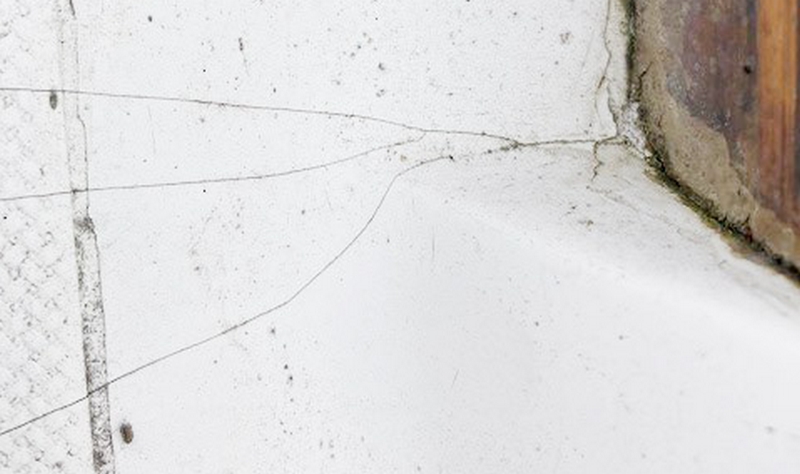
These gelcoat cracks are stress cracks at the corner of a companionway.
A concentrated grouping of cracks generally running in the same direction indicates a more than severe trouble. This is frequently establish on the leading edge of the cabin pinnacle where information technology meets the deck. This tin exist the issue of a high flex surface area indelible heavy seas or also much load on the boat. Cracks may also form at a bulkhead or other hard spots behind the fiberglass when the gunkhole flexes, creating pressure.
To repair this type of groovy, remove the gelcoat from the area and inspect the fiberglass for deeper cracks. Simply wipe the area with a wet fabric then the cracks or fractured fiberglass volition appear as white lines in the laminate.
Continue until the fractured laminate is removed, and then exercise a traditional fiberglass repair post-obit these steps:
Grind out the surface area to a taper of 12 to 1 from the deepest betoken.
Cut fiberglass patches starting with the largest first, working your way smaller to fill the surface area that has been ground abroad.
Using WEST SYSTEM Epoxy, wet out the fiberglass pieces and apply them to the repair surface area, starting with the largest patch kickoff and working your way to the smallest. Let the epoxy cure.
Wash the area with water and a nylon scrub pad to remove whatsoever amine blush, and sand the repair off-white with the surrounding area. If in that location are low spots, thicken Due west SYSTEM Epoxy with 407 Depression-Density Fairing Filler and use it as a fairing compound to make full in low areas. Let the epoxy cure, launder it, and sand it to shape.
After final fairing, use two coats of unthickened WEST Organization Epoxy to seal the repair area.
Wash and sand the cured seal coat of epoxy then employ a topcoat of paint or gelcoat. Meet Fiberglass Boat Repair & Maintenance, pages 19-25 for detailed instructions.
Thermal Fatigue Gelcoat Cracks
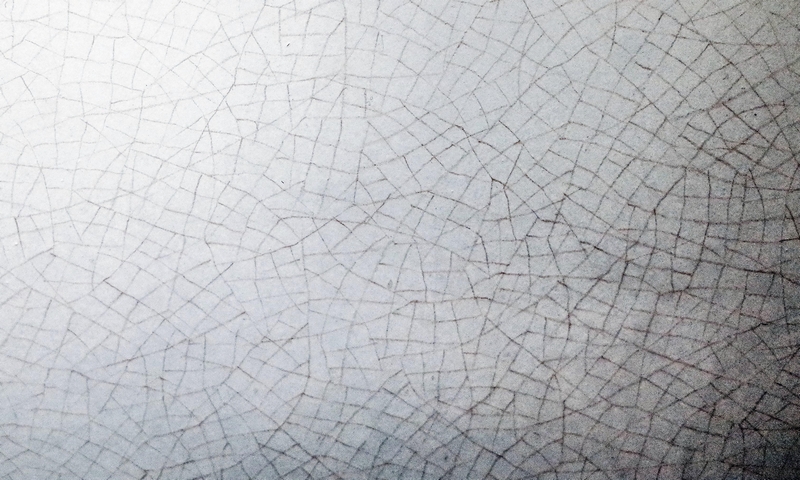
Brusque, random cracks are chosen "crazing."
The environment tin can dramatically affect gelcoat. Wax can protect information technology from fading but there is no mode to protect gelcoat against the repetitive expansion and contraction of temperature change. This movement tin cause great, which may announced in a parallel or a random pattern.
Parallel patterned cracks will vary in length from short to several inches and are a few to several inches apart. I have heard them referred to every bit sometime historic period cracks. Often these are caused by an expansion of the deck laminate, making the gelcoat more susceptible to flexural stress.
Short, random cracks are also referred to as gelcoat crazing. Crazing can be localized to a small area or completely cover a deck. I take seen cockpit soles that remind me of a shattered car window. Crazing is caused past the gelcoat expanding and contracting over a given area.
We become client calls request if sanding the gelcoat and rolling epoxy over information technology volition fill the gelcoat cracks and prevent them from returning. Sadly, the answer is no. Cracked gelcoat should be removed. After gelcoat removal, sand the fiberglass laminate with 80-dust sandpaper. After sanding, make whatever needed repairs to the surface area. Roll on a minimum of three coats of WEST Organization® Epoxy to seal the fiberglass before applying a finish coat of pigment or gelcoat.
When gelcoat bang-up is a symptom of another problem, repairing the crack and not repairing the underlying cause could lead to repeated groovy. In the case of a thick gelcoat, thinning the gelcoat is non practical.
After the repairs are completed, some boats remain fissure-gratuitous for years. Taking your time and doing the job right will pay dividends in fourth dimension and money.
Our Fiberglass Boat Repair & Maintenance transmission has illustrated instructions on many aspects of fiberglass boat repair, including gelcoat repairs. It'south bachelor for free download in the instruction section on westsystem.com.

How To Fix Gel Coat Cracks,
Source: https://www.epoxyworks.com/index.php/repairing-gelcoat-cracks/
Posted by: holimansque1965.blogspot.com
0 Response to "How To Fix Gel Coat Cracks"
Post a Comment